

Introduction
The Mauritanian Mahdra — المحظرة الشنقيطية — stands as one of the most distinguished traditional scholarly institutions in the Islamic world. Its emergence is inseparable from the cultural and intellectual history of Bilad Shinqit, the land known today as Mauritania. For centuries this institution has preserved and transmitted the Islamic sciences and the Classical Arabic language across the Sahara and throughout West Africa.
What makes the Mahdra remarkable is that it arose entirely outside the formal structures of the state. It was sustained not by government funding or institutional bureaucracy, but by the dedication of scholars and the support of local communities — a living proof that genuine scholarship needs no bureaucratic scaffolding to endure.
Historical Origins
The roots of the Mahdra reach back to the earliest spread of Islam in the Western Sahara, when the need arose to teach the Quran and the religious sciences to the local population. A number of researchers trace the beginnings of organized scholarly activity in the region to the fifth Hijri century — the eleventh century CE — when the religious reform movement led by the caller to Islam, Abdullah ibn Yassin al-Jazuli, became active in spreading religious education and establishing circles of learning across the desert.
Over time these circles evolved into dedicated educational institutions that came to be known as Mahadher — plural of Mahdra. What began as informal gatherings around a scholar grew into a structured, recognized system of knowledge transmission that would shape the Islamic scholarly world for a thousand years.
The Cities of Knowledge
The Mahdra flourished in historic cities renowned for their scholarly standing — Shinqit, Wadan, Walata, and Tichit. During the medieval period these cities transformed into prominent intellectual centers that drew students of knowledge from across the Sahara and the Western Sudan. They housed scholarly libraries and circles of learning, creating an environment ideally suited to the flourishing of serious academic culture.
These were not merely towns — they were living universities embedded in the desert landscape, where manuscripts were produced, preserved, and studied across generations. Out of 10,000 manuscripts recovered from Mauritania, 5,000 are original works authored by local Shinqiti scholars — a staggering testament to the depth of intellectual output this tradition produced.
What Is the Mahdra — A Definition
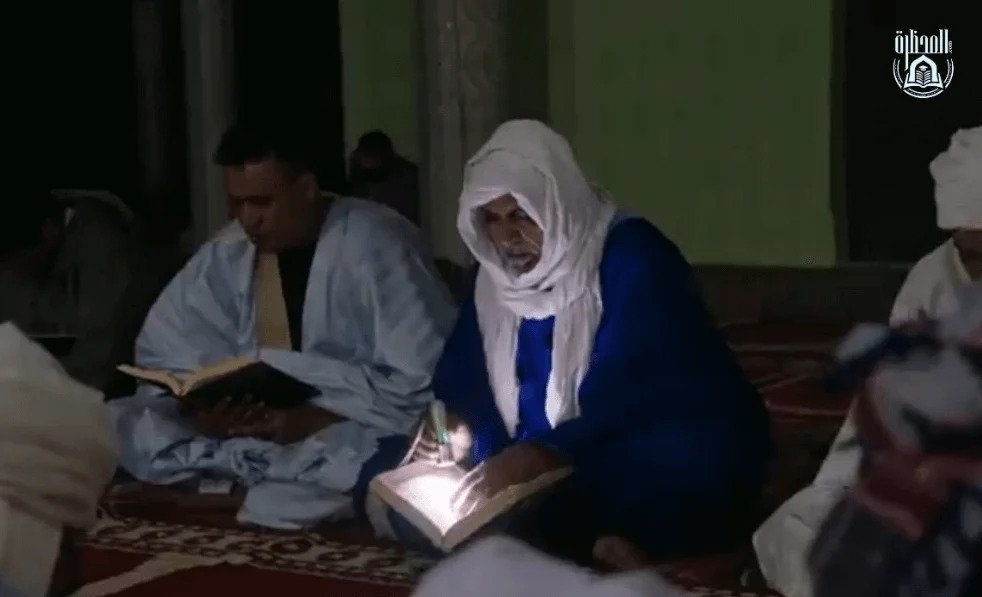
At its core, the Mahdra is a traditional educational institution overseen by a scholar — a Sheikh — who takes responsibility for teaching the Islamic and linguistic sciences to a circle of students. Its physical structure is deliberately simple: a tent, a modest house, or the shade of a tree. The value of the Mahdra lies entirely in the knowledge the Sheikh transmits and the method by which he transmits it — not in buildings or infrastructure.
This simplicity is not poverty — it is philosophy. The Mahdra embodies the Islamic scholarly conviction that knowledge travels through people, not through institutions. A man who has mastered the sciences of Nahw, Sarf, Balagha, Fiqh, Hadith, and Tafsir carries a complete university within himself, and needs only students willing to sit and learn.
Distinctive Characteristics of the Mahdra
- Comprehensive Curriculum
The Mahdra was never limited to teaching the Quran and Fiqh alone. Its curriculum encompassed the full range of Islamic sciences: Hadith, Tafsir, Usul al-Fiqh, Aqeedah — alongside the complete Arabic language sciences including Nahw (grammar), Sarf (morphology), Balagha (rhetoric), and classical literature. This breadth produced scholars of encyclopedic formation — the hallmark of the Shinqiti scholarly identity that became famous across the Muslim world.
- Memorization as Foundation
The Mahdra relied fundamentally on the method of memorization and mastery — Hifz and Istidhar. Students were required to memorize the core classical texts across every science. This approach produced scholars distinguished by extraordinary memory and vast knowledge — a characteristic the Shinqiti scholars became famous for throughout Islamic history. A student does not simply study the Alfiyyah of Ibn Malik. He memorizes it — all thousand lines — and then studies its meaning under a scholar who has done the same.
- Openness and Social Accessibility
The Mahdra imposed no formal conditions for enrollment. Anyone who sought knowledge could join, regardless of age or social class. Students typically lived near the Sheikh and participated in the daily life of the community — learning was not confined to a classroom but infused into existence. The student who woke for Fajr prayer beside his Sheikh, who ate with him, who watched how he lived, was absorbing a form of learning no institution could replicate.
- The Nomadic Character — Knowledge That Moved
Due to the nature of Saharan desert life, some Mahadher traveled with their tribes during seasonal migrations. This characteristic — unique to the Mauritanian tradition — meant that education reached vast stretches of the desert and arrived in remote communities that no fixed institution could have served. Knowledge did not wait for students to come to it. It traveled to find them.
The Mahdra’s Role in Spreading Islamic Culture
The Mahdra played a pivotal role in spreading Islamic culture and the Classical Arabic language throughout Mauritania and West Africa. Its graduates — scholars who carried the full traditional curriculum within them — went on to establish new schools across the region, extend the reach of Arabic scholarship into previously unreached communities, and contribute to the Islamic jurisprudential and educational infrastructure of an entire continent.
The Mahdra also served as the primary guardian of Mauritanian cultural and religious identity through long stretches of history. Its graduates held the positions of judges, jurists, and teachers. In periods where no other institution stood, the Mahdra stood. It educated the generations and formed the scholarly and religious elite of the society across successive centuries.
Challenges and Survival
The Mahdra faced significant challenges during the French colonial period, which sought to spread modern French-language education and marginalize the role of traditional learning. Yet despite these pressures the Mahdra maintained its presence in society — sustained by its deep rootedness in the religious and cultural identity of the people. An institution that carries the identity of a community within it cannot easily be displaced by an external power.
In the post-independence period the spread of formal schooling and the emergence of universities brought further transformation. The Mahdra’s relative prominence diminished in some respects — but its scholarly standing and cultural significance in Mauritania remain intact. It is not a relic of the past. It is a living tradition that continues to produce scholars today.
Conclusion — A Tradition That Reaches You
The Mauritanian Mahdra represents a singular educational experience in the history of Islamic learning. In a harsh desert environment, with no state support and no institutional infrastructure, it constructed a complete and rigorous system of knowledge that spread Islamic scholarship across a continent and produced some of the greatest Arabic scholars in Islamic history.
This institution is not merely of historical interest. It remains a living part of Mauritania’s scholarly and cultural heritage — and through AlMahdra.com, for the first time in history, its method and its scholars are accessible to students anywhere in the world. The chain of transmission that began in the desert of Bilad Shinqit over a thousand years ago now reaches you.
Recent Post

Classical Arabic is among the oldest and richest of the [...]