
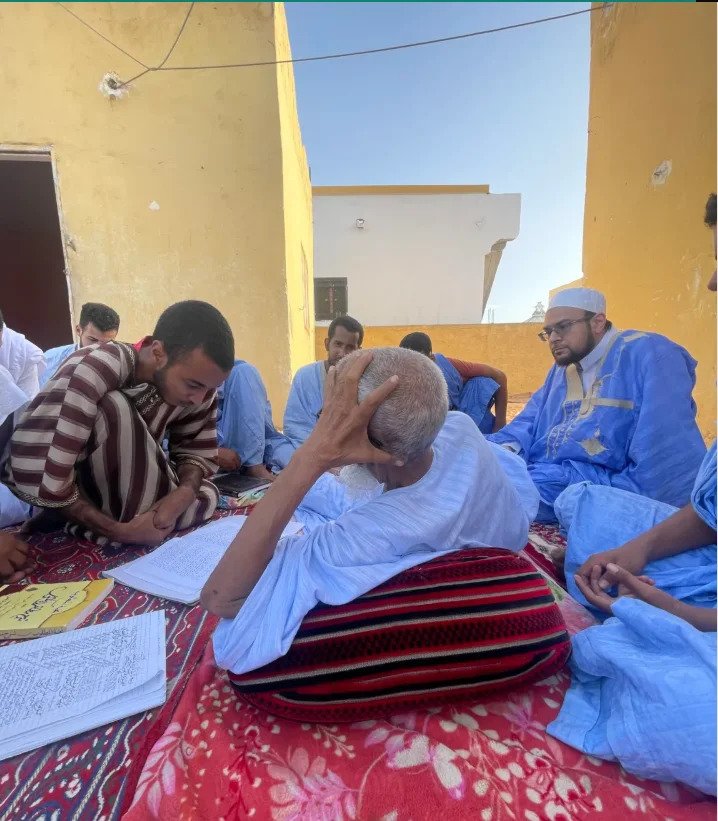
For many students, learning Arabic feels like an endless loop of vocabulary lists, confusing grammar rules, and slow progress in reading real texts. The Mauritanian mahdhara tradition offers a different path. It is not a “hack” or a shortcut, but it is a highly structured system that has produced strong Arabic readers and scholars for generations. What makes it effective is not one magical technique, but a set of learning principles that reinforce each other: precision, repetition, memorization with meaning, and early exposure to classical texts.
A disciplined relationship with the text
One of the biggest strengths of the mahdhara approach is that it trains students to treat Arabic as a language of texts, not just a set of conversational phrases. From early stages, learners engage with foundational works (often short, dense classical summaries) and gradually build the ability to read and analyze original sources. This shapes the mind around how Arabic is actually used in scholarly writing: tight grammar, rich morphology, and compressed meaning. As a result, students often develop reading strength faster than those who spend years in “general Arabic” courses without sustained text work.
Memorization that creates fluency, not just recall
In modern education, memorization is sometimes criticized, but the mahdhara uses memorization in a specific way: to automate core language patterns. When a learner memorizes key definitions, rules, and examples, they reduce cognitive load later. Instead of “thinking through” every grammatical decision, the student begins to recognize patterns instantly. This is similar to how musicians internalize scales or how athletes drill basic movements. Over time, memorized material turns into fast recognition, and fast recognition turns into reading fluency.
Incremental mastery through repetition and review
The mahdhara method is built on frequent review. Students repeat lessons, re-read passages, and revisit rules until they become stable. This aligns with what learning science calls spaced repetition and retrieval practice: the idea that recalling information repeatedly over time is one of the most reliable ways to strengthen memory and skill. Many learners fail in Arabic because they “move on” too quickly. The mahdhara system tends to prevent that. It assumes that mastery is not linear; it requires looping back until the foundation is unshakeable.
A curriculum that prioritizes structure
Another reason the method works is that it teaches Arabic as an interconnected system. Grammar (nahw), morphology (sarf), and vocabulary are not treated as separate subjects that you study randomly. They are built as layers. The student learns how words are formed, how endings change meaning, and how sentences are constructed, then applies that knowledge directly to real text. This produces clarity. When a learner knows the structure, Arabic becomes less mysterious and more predictable.
Training attention and precision
Mahdhara learning encourages careful listening, accurate recitation, and detail-oriented correction. That kind of training develops strong linguistic attention: you learn to notice vowel endings, patterns of verb forms, and subtle grammatical signals that many learners ignore. In Arabic, these details matter. A small change in vowel marking can shift meaning and function. Students trained in precision often become more confident readers because they trust their analysis.
Teacher-guided feedback and accountability
In traditional settings, a teacher corrects students regularly and expects consistency. This feedback loop is crucial. Many self-taught learners can read “some Arabic,” but they stabilize mistakes because nobody checks them. The mahdhara model reduces that risk by emphasizing correction, accountability, and guided progression. Even when adapted online, this principle remains powerful: learners progress faster when they receive targeted feedback on recurring errors.
Strong outcomes for classical Arabic goals
It’s important to be honest about what the mahdhara method is best at. It is especially effective for students whose goal is classical Arabic: reading heritage texts, understanding grammar deeply, and accessing scholarly literature. It may not be the fastest route for casual travel conversation. But for serious students aiming for long-term literacy and comprehension, it builds the exact skills that matter: parsing sentences, recognizing patterns, and reading without translation crutches.
Conclusion
The effectiveness of learning Arabic through the Mauritanian mahdhara tradition comes from its coherence. It trains the learner’s memory, attention, and analytical skill in a way that supports real text comprehension. It is demanding, but its demands are purposeful. For students who want more than surface familiarity, the mahdhara method offers a time-tested blueprint: learn the foundations, internalize them through repetition, and apply them directly to the texts that define the Arabic language.